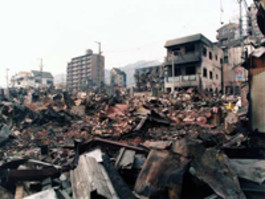
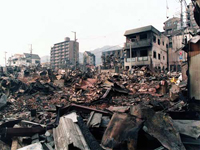
 “An estimated 1 million kids orphaned by quake.” That stunning headline is enough to break your heart, isn’t it? Barely two weeks into the Haitian catastrophe, and the unfolding saga keeps peeling back layer after layer of the immense heartache and suffering that our Caribbean neighbors are enduring.
“The children with no names lay mute in a corner of the General Hospital grounds Tuesday, three among thousands of boys and girls set adrift in the wake of Haiti’s earthquake. ‘Hi, Joe, how are you?’ the American doctor tried, using a pet name the staff had given a boy of about 11. There was no response. ‘Joe,’ ‘Baby Sebastian’ and the girl who didn’t even have a nickname hadn’t spoken or cried since they were brought over the previous 48 hours—by neighbors, passers-by, no one knows who. ‘Sebastian,’ only a week old, was said to have been taken from the arms of his dead mother” (SBTribune 1-27-10).
A CBS Evening News reporter trailed along with one boy, 10 or 11 years old, who was wandering the crowded streets of Port-au-Prince, his parents dead from the quake. “And where do you sleep at night?” The boy led the camera and reporter to a concrete ledge surrounding a broken city fountain. He climbed up onto the ledge, curled his legs under him to show the visitors how he passed the lonely, comfortless nights.
Researchers describe two very real human responses to televised catastrophes. First, there is “frozen emotions”—the mental numbness that eventually steels the heart from responding after viewing repeated portrayals of human suffering. Soon, it’s just more news—and we become unaffected. The second response is “donor fatigue”—a weariness from the barrage of appeals that eventually shuts off the flow of compassionate response. None of us is immune to either reaction.
So what can we do for the orphans, how shall we continue to respond to the sufferers? What did Jesus do? Because of his three and a half years of ministry in Palestine, the world was not suddenly relieved of its wider suffering. The truth is only a relatively small proportion of humanity was affected by Jesus’ compassionate response. Why? Simply because he couldn’t be everywhere. But he could be fully engaged with the suffering that surrounded him. Couldn’t that be our response, too? Yes, we must continue to support the compassionate interventions of disaster response teams like Adventist Development and Relief Agency (www.ADRA.org needs our contributions). But like Jesus we must also become engaged with suffering needs that surround us. The soup kitchen, the street ministries, the Harbor of Hope’s Kids’ Zone at our church plant—just twelve miles up the road are compelling needs waiting for compassionate volunteers. So won’t you pray for Haiti, give to Haiti, but “unfreeze” your emotions and make a difference right by volunteering here at home? After all doesn’t it say somewhere, “Many are called, but a few are frozen”? Then let’s unfreeze for Christ!
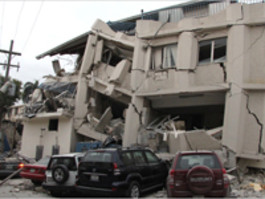
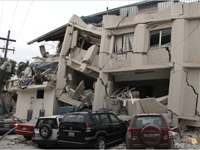 Haiti’s devastating earthquake on Tuesday afternoon is our crisis, too. As I sit here and write the next morning, initial reports from Port-au-Prince indicate that much of the capital city of nearly 1.5 million residents lies buried beneath collapsed rubble, as the result of the 7.0 magnitude record-breaking temblor. The Parliament building, the presidential palace, the United Nations mission headquarters, hospitals, schools, churches and untold numbers of apartments, houses and tenement buildings have been flattened. How many lives have been lost in this epic disaster no one, of course, yet knows. Some already fear untold thousands of casualties.
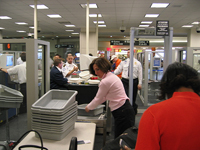 Do you really think new “pat down” measures at the airport will make air travel more secure? I read a piece by syndicated British columnist Gwynne Dyer, and I’m afraid he’s right. In response to the Christmas Day attempt to bring down that Detroit-bound airliner through concealed explosives on one of the passengers, government officials have had to devise some sort of official “upgrade” to our present travel security to assure the traveling public that the skies once again are “friendly.” Dyer comments, “It is the duty of all public officials to ‘do something’ whenever a new threat appears, even if there is nothing sensible to be done.” The truth is that profiling international travelers by nationality or country of birth or origin (as the new security regulations do) not only lumps vast numbers of innocent people into the category of “suspicious” (or, guilty until proven innocent), it assumes that terror and terrorists are limited to these watch-listed nations (which is hardly true). And as for hand searches, most agree that the only effective method of full-body screening would need to include “body cavity searches.” And the public will not stand for that, will we?
 Poor Jesse Sheidlower, editor at large of the Oxford English Dictionary—he can’t even show up at a holiday party without being cornered by another distraught denizen of the English-speaking world with the query, “What are we supposed to call the decade that’s now ended?” Pretend you’re the editor of the dictionary—how would you answer all those emails? After all, we call the 80’s the 80’s and the 90’s the 90’s. But what shall we call the 00’s? The Zeroes? Hardly. How about the Aughts (English for the number 0)? Or the Ohs? Or the Oh-Ohs (I like that one!)?
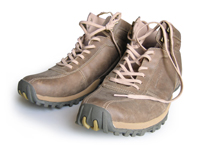 “I complained to God that I had no shoes, until I met a man who had no feet.” That dusty line from Thanksgivings past finds fresh meaning in Derek McGinnis’ new book, Exit Wounds: A Survival Guide to Pain Management for Returning Veterans and Their Families. November 9, 2004, Navy corpsman McGinnis was in Fallujah, Iraq, racing in an ambulance to pick up injured Marines, when a Mercedes Benz packed with homemade explosives crashed into his side of the ambulance, severing his left leg above the knee and exploding shrapnel into one eye. After years of rehabilitation at Bethesda Naval Hospital, Walter Reed Army Medical Center, and the Palo Alto Veterans Hospital, 32-year-old husband and father Derek is focusing his life now on assisting other veterans and families who are having to pick up the pieces and cobble together a life beyond the war. A consultant with the American Pain Foundation, he is spreading a message of hope beyond adversity. “It’s OK to have mental pain, it’s OK to have physical pain. There are methods to have a productive life” (SBTribune 11-18-09). The proof hangs in the McGinnis garage at home—the racing bibs of a long distance runner: the 2006 Marine Corps Marathon, the 2006 Army 10-Miler, and the 2007 Alcatraz Challenge. All of the races run with a flexible prosthetic left leg replete with a neatly-laced running shoe at the end of the metal post. Derek McGinnis is grateful to be running at all.
 Amen to AMEN! Karen and I had the privilege of joining several hundred physicians and dentists and their families this past weekend in Gatlinburg, Tennessee. You should’ve heard their stories. Here they are—medical professionals in the thick of their careers across this nation—pursuing Christ in the marketplace of health care. Or, as dentist Dusong Kim described it, it was Christ in hot pursuit of him, as the Cessna twin engine he was piloting in the dark over an invisible patch of California below, dropped out of the night sky, its engines shut down. Clutching the stick in desperation, his mind racing, his wife and two small children strapped in beside and behind him, this dentist at the apex of a lucrative practice recounted those life-altering moments as he blindly crashed the craft into an orchard of almond trees. But out of that survival, his testimony described a redirected career, ignited by a new passion for God and his mission. Or there was young orthopedic resident Joshua Drumm, who discovered that his lifelong ambition to become an orthopedic surgeon was tanking, simply because he refused to attend the residency application interview on Sabbath. The drama of his pleading before God, the subsequent rejections from elite orthopedic residencies across the nation once his Sabbath conviction became known, his refusal to compromise his commitment to his Creator, the Philadelphia hospital orthopedic chief’s repeated attempts to persuade Joshua otherwise—his was a shining testimony of trust in God for all of us who listened, medical professionals or not. Today Dr. Kim and his family are missionaries in Bolivia. And Dr. Drumm and his wife are in a successful orthopedic residency in Philadephia. “Faith in practice”—the weekend theme for this retreat—is more than evident in the lives of these many medical professionals. And on this campus of over 3500 young adults, how many of them, how many of you, will also hear the call of Christ to follow him as a medical missionary? Perhaps not to some foreign shore, but nevertheless you are being called to be a missionary for the kingdom right here at home in this nation. Massive student loans, society’s drumbeat to reflect the affluence accorded your medical station in life—there will be myriad pressures to turn a practice into a lucrative career. But I was impressed with this hotel ballroom full of medical professionals who have chosen to reject societal norms and instead plunge into a self-sacrificing life of healing our broken world in the name of Jesus. You can be one of them one day. Why the name AMEN? Because it stands for Adventist Medical Evangelists Network. Doctors, dentists, health care professionals as evangelists? Why the surprise? After all, God had only one Son—and he called him to be a medical evangelist. Could you be in better company?