With forty-one candidates for president, Thursday’s election in Afghanistan certainly won’t be remembered as offering too little choice for the people of that war-torn nation. Although with the Taliban’s dark threat to kill poll workers and voters alike who show up for this national exercise in fledgling democracy, the choice for many may simply have been between life and death.
At the risk of oversimplifying the issues and demonizing the opposition, the parallels between the Afghan crisis and the intergalactic civil war that grips our own universe are striking. If the ancient Scriptures are to be believed, the divine Sovereign of the universe has risked the very existence of his government by granting to all citizens in his cosmic domain the inalienable right to choose whom they would have as Leader. Because of that guaranteed freedom, an angelic being long ago chose to reject the authority of the ruling God and rebel against his administration, thus igniting an internecine conflict that has now been isolated to this single planet in the galaxy and universe.
And on this planet that you and I call home leaflets from the sky have been announcing the final election of Leader for the citizens of earth. Although in our case, there are no forty-one candidates—there are only two: the apocalyptic dragon and the apocalyptic Lamb. And as surely as it was in Afghanistan, so for this election it has become the choice between life and death. But because it is still a choice for this planet’s inhabitants, the opposition’s guerilla warfare is an overt and obvious attempt to dissuade us all from voting at all—which would leave us plunged in the bloody status quo of this planet in rebellion.
Even a university campus like our own becomes a battleground for voter loyalty and citizen allegiance. None of us is accidentally thrust into this final election. The small choices of our day and night existences accumulate to become our final vote. “‘Choose for yourselves this day whom you will serve. . . . But as for me and my household, we will serve the LORD’” (Joshua 24:15).
Because this election is so critical and because the final vote is potentially imminent for you and me, we plunge next week into a new exploration, “The Temple.” What is it that is transpiring in the throne room of the universe—even as we write and read these words—that carries eternal consequences for us here below? The unfolding events in the war room of the divine Candidate surely are consequential for the choice you and I must finally and fully make. Come to “The Temple” here at this website and at Pioneer Memorial Church Saturday mornings beginning next week. An educated electorate is liberty’s greatest hope.
 Before we consider “Cash for Clunkers,” the government’s latest stimulus project, I’d like to thank our guest bloggers and preachers who allowed me to spend the last six weeks finishing a devotional book manuscript and marrying our son Kirk to our new daughter-in-law Chelsea. But of course, the preachers weren’t “guests” at all, but rather key leaders and pastors on our senior leadership team here at Pioneer. Without their passion for Christ and ministry, we wouldn’t be the Pioneer we are. So, thank you! Karen says that when it comes to the passage of time, I’m no optimist. It didn’t help that when May came I began announcing that the summer was essentially over. But I couldn’t help it, and turns out it was true! Anybody know where this summer sped? The school bells start clanging bright and early Monday morning—and a brand new adventure is launched. And that goes for Pioneer, too. In two weeks we begin what I’m praying will be a life-changing journey into “The Temple,” our new fall pulpit series that begins August 27. I hope you can share the voyage on Saturday mornings at Pioneer or 24/7 at
  Moses Maimonides, a physician and rabbi who lived in the twelfth century, worked in the court of the sultan of Cairo by day and cared for the destitute of that city by night. He began each day with the following prayer:
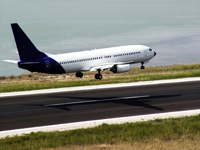 Ever feel like the flight you’re on is going down? Karen and I just returned from two weeks in Europe—taping a Waldenses documentary (for the Andrews University School of Architecture) in Torre Pellice, Italy, and celebrating our 35th wedding anniversary in Grindelwald, Switzerland. After the recent Air France Flight 447 tragedy, travelers are even more sensitive to the possibilities of midair trouble. But our overnight flight to Europe was uneventful—until about five minutes before landing in Frankfurt, Germany—when there was a loud explosion near where we were seated, two rows up and on the opposite side. The explosion was followed by a loud roaring sound that only grew louder as we flew. Suddenly yellow pieces of insulation began shooting up from the aircraft wall into the cabin. A couple passengers jumped from their seats and fled to the other side. And we all began coughing from the insulation in the air. I don’t mind admitting it was a scary time. Your mind and heart are racing over the unknown. Is it a fire, or did a hole blow in the side of the Boeing 777? Naturally we were praying. The flight attendant on our side was yelling that her intercom was cut off. And I’m quietly thinking that this flight isn’t going to make it to the airport. But all the while there was no erratic movement of the plane. And eventually the loud roaring sound quieted away. Only coughing now. You can understand the relief in the air was palpable when the wheels finally touched down and passengers began applauding. Soon the copilot came on the intercom and in the great understatement of our flight announced: “Some of you may have heard a sound in the rear of the plane . . .” He informed us that one of the hydraulic lines running down the side of the aircraft had burst open, spewing insulation into the cabin. We have no idea where the line ran to—but praise God it apparently wasn’t to the wings or tail flaps. We were safe—hallelujah! Moral of the story—we must never take for granted our prayers for each other’s safety. Life is an uncharted flight at best. And while God is the pilot (like the sign in front of the church said, “If God is your copilot, you’re in the wrong seat!”), life can still be unpredictable. And uncertain. Hence our need of each other’s prayers. In that regard I solicit yours as I begin a writing sabbatical, to finish a 366-page devotional book for the Review and Herald Publishing Association that I began last summer. Eight months of devotional readings are now written, leaving me to write the four months of September through December over the next four weeks. So please claim Philippians 1:6 on my behalf—“He who began a good work in you will carry it on to completion until the day of Christ Jesus.” And that, by the way, will be one flight guaranteed not to go down . . but up forever and ever. Amen.
 Until the black boxes can be retrieved, the cause of the crash of Air France Flight 447 over the Atlantic Ocean Sunday night will remain unresolved. Some have speculated that the aircraft suffered a midair disaster related to what scientists call the "intertropical convergence zone"—a nearly continuous band of colliding weather systems that stretches across the Atlantic at the equator from South America to Africa. The ICZ is the hotbed of some of earth's strongest storms, with massive thunderheads at times towering up to 60,000 feet above sea level. That has led some to speculate the aircraft flew into that brewing meteorological cauldron and suffered a catastrophic event associated with the weather. The discovery of floating aircraft debris two days later was grim confirmation that all 228 people aboard perished on that ill-fated flight. And we grieve for their loved ones. The reality is that all trans-Atlantic flights must fly through a "no radar" zone, a space above the ocean beyond the reach of air traffic controllers on either side of the Atlantic. Hundreds of flights every day traverse that swath beyond the reach of radar for hours at a time. Naturally, pilots rely on the on-board radar systems that monitor surrounding weather and other aircraft to assure their safe passage. The tragic accident Sunday night is a reminder that the forces of nature are unpredictable at best. Is it any different with life? Clear skies can morph almost instantaneously into a deadly brew of trouble. A phone call at 2 a.m., a doctor's grim report of the test results, an unobserved vehicle flying through a red light, even an innocuous little email—have you noticed, unforeseen high altitude turbulence can throw your life into a tail spin in a split second? For those times we all have faced and will yet face ahead, I'm grateful there is no swath of air space we traverse that is beyond instantaneous contact with God. It may feel like he's asleep in the midst of your storm right now. And it may appear that you are going down. But in that midnight fury when the panicking disciples cried in desperation, "Lord, save us," the gospels shout into the wind the good news that Jesus stands up in your crisis and raises his hands to the maelstrom with the quiet command, "Peace—be still" (Mark 4:39). A supernatural peace in the midst of the storm is only a three-word prayer way: "Lord, save me." For truth be known, God isn't within radar contact—he’s at the controls of your flight. And no matter how stormy the night, he will have the last word. Even if your flight goes down.
 The CNN.com headline caught my eye: "Americans not losing their religion, but changing it often." The lead story was of Ingrid Case, a 41 year old freelance writer and editor in Minneapolis, who grew up an altar girl (acolyte) in her Episcopalian church. But after college, she drifted away, uncomfortable with her church's theology, eventually meeting and falling in love with a man who himself was searching for religion. Eventually the two of them joined the Society of Friends and became Quakers. She told the reporter, "It wasn’t so much 'You people stink and I'm out of here,' as 'I like this better and this is what I want to do.'"
 "Where do they all come from?" You can't help but wonder when you drive the freeways of southern California—which we were doing last weekend for the wedding of my nephew, Vaughn Nelson. As we drove back from San Diego to my mother's home in Banning late Sunday evening, the stream of red taillights flowed ahead of us like a winding crimson river, matched only by the yellow-white streak of headlights flowing toward us on the opposite side of the night median. "Where do they all come from?" California boasts more licensed drivers (nearly 23 million) than any other state. And Sunday night half of them must have been on the highway! Makes you wonder, doesn't it? When God gazes down upon this aging planet in the night, what is it he sees? The white-laced blue-green curvature of our earth as seen by the orbiting Shuttle astronauts above us right now? Or does his sweeping eye zoom in much, much closer—beyond the wispy wide-angle shot to a telephoto deep into the dark heart of earth’s inner city thoroughfares? Calcutta, Beijing, Los Angeles, Tokyo, Mexico City, Sydney, Cairo, London, Chicago, Benton Harbor—are we a stream of headlights and taillights to him? "For the eyes of the LORD range throughout the earth" (II Chronicles 16:9). After all, even if we are a rebel race on the run, aren't we still his children? And if we are, then wouldn't a paternal heart of love be on the move 24/7 in hopes of finding even one—just one—runaway lost in the dark but who may be searching for the road to come home? No wonder he peers amidst the ribbons of dark and light: "The eyes of the LORD are on those whose hope is in his unfailing love" (Psalm 33:18). But how can they hope in One they do not know? And how can they know, if they do not hear? And how can they hear, if they are not told? You can't drive away from that stream of headlights without wondering if you're doing all that is in your power to tell them... at least one of them... can you?
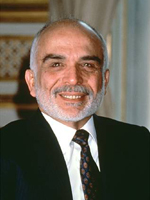 I sat in on a conversation with His Royal Highness King Hussein of Jordan the other day. It wasn't in person, of course—audiences with a king aren't even a once-in-a-lifetime opportunity. But I listened as the king and David Gregory, of NBC's Meet the Press, discussed the precarious challenges of a new Middle East peace. Jordon on one side of the river that bears the same name, and Israel on the other side. And in between and throughout both kingdoms the Palestinian people. And I try to imagine how deeply the God of the universe desires a lasting peace accord. There is a city that all the region's peoples hold sacredly to their hearts—Jerusalem, or Zion, as the Old Testament often called her. Early this morning I came across a dusty line from long ago that spoke such a profound promise for Zion, that it's become the grist for my brooding all day. For in these words I hear a pleading prayer to the God of all the earth to deliver spiritual Zion, composed of peoples not only of the Middle East, but of all the earth: "You will arise and have mercy on Zion; for the time to favor her, yes, the set time, has come" (Psalm 102:13). Hasn't the time come for God to have mercy on his community of faith—this spiritual city of the faithful the world over? I'm not thinking Jews or Muslims or Christians or even pagans right now. I'm wondering if this isn't a prayer whose time has come for all of the earth children who long for God to step in and save this planet one more time. As I travel the world and this nation, I meet them again and again—men and women, often professionals and business people the next seat over on that flight, whose minds are open to a radical spiritual paradigm shift, the very shift predicted in the Apocalypse: "Then I saw another angel flying in the midst of heaven, having the everlasting gospel to preach to those who dwell on the earth—to every nation, tribe, tongue, and people . . ." (Revelation 14:6). How is God going to pull off such a radical apocalyptic mission to the entire civilization without pouring out his favor and mercy upon spiritual Zion? For unless the church of Christ is dramatically revived, all the royal highnesses in the world won't be able to usher in the long-promised peace. God has chosen to commit his strategic endtime mission into the hands of a very frail and often failing community of faith. I repeat, unless the "set time" for his favor and mercy comes, Zion will muddle through the years, unable to arise to any apocalyptic closure. Could it be God awaits our pleading? Would you be willing to join me in praying the psalmist's prayer? Hasn't the time for God's favor come? Isn't it high time for the church to cast off her hankerings for this fallen culture and offer herself unabashedly to Christ? For if we aren't passionate for him, how will we ever become passionate for his mission? Our board of elders meets today in a special focus on prayer. Next week we begin a new mini-series, "The Issachar Factor," that will call us to such passion. But in the mean time, you and I can lift up this very prayer to God again and again and again. After all, it's the only audience with a King that can answer this prayer.