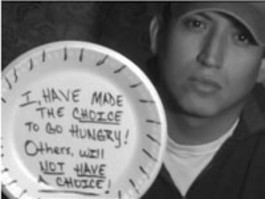
 A friend of mine sent me a MoveOn.org communiqué. Please don’t judge my friend (or me) by that action! I realize it’s a bit risky even mentioning this national left-of-center organization of political activists. But I’m also going to risk alienating a generation of young activists (which most of “this generation” is—whether left-of-center, right-of-center, middle-of-center, wherever that is) by commenting on the particular cause-response for which this MoveOn.org email is recruiting.
The cause? The just-voted (by the midnight deadline) compromise budget agreement adopted by the House and Senate of the U.S. Congress. Incensed with some of the announced “immoral budget cuts,” MoveOn solicited the popular recording artist, Moby (I had to go online to find out who he was), to record a YouTube piece decrying the government’s abandonment of children, the young, the elderly in favor of corporations and the wealthy. (It’s more of the hackneyed political debate that we’ve become accustomed to in this nation—both sides/parties zealously resorting to over-kill to drive home their agendas.)
But leaving that debate for others, consider for a moment MoveOn’s protest strategy. They are recruiting 30,000 Americans to voluntarily undergo a food fast to show solidarity with the economically disenfranchised in this nation. Give up eating a meal or two, for a day or two, to show the nation’s leaders how concerned you are over the plight of the poor, and the government’s response (or lack, thereof). “30,000 people fasting” is the email’s subject line.
Why talk about this at all? Because what struck me, as I watched the faces of ordinary Americans holding up empty plates with words of protest scribbled onto those plates, was the question: What if we—the young and old in the church—felt as deeply about the spiritual poverty and spiritual starvation of our nation, our world, our civilization? How willing would we be to fast from food—not to move Congress, but to plead with the God of the universe to give us his heart for the starving and then give us the courage to become missionaries for him to America, to the world, to every soul we know hungry for the Bread of Life?
How serious is the famine of spiritual starvation? “‘Behold, the days are coming,’ says the Lord GOD, ‘that I will send a famine on the land, not a famine of bread, nor a thirst for water, but of hearing the words of the LORD. They shall wander from sea to sea, and from north to east; they shall run to and fro, seeking the word of the LORD, but shall not find it’” (Amos 8:11, 12). The prophet declares that one day there will be no Bread of Life left for the starving—civilization as we know it will implode upon itself.
But that day is not here yet. There still is time to take Christ, the only satisfying Bread of Life (John 6:35), to this starving generation. We must never fast from that Bread. But perhaps we, too, might do well to fast from our daily bread and pray, in order to seek the mind of God for the part he would have us play in his endtime “spiritual famine relief.” Once you have the Bread for yourself, there’s no telling where the Spirit will send you in order for you to share it. Move on, indeed! Because there is a hunger no government on earth will ever be able to satisfy. And because if we don’t, people will starve to death. So what will be your next move?

 The western media have begun to banter about the suggestion that this winter’s political upheaval in the Middle East is like a spring thaw, warming heretofore rigid dictatorial or monarchical governments into pliable, receptive fields for democracy. The “Arab Spring” they call it. First Tunisia and Egypt—now Bahrain, Yemen, Syria, Jordan and possibly Libya. Is it an Arab Spring, a new opportunity and season for the will of the people? Allah akbar! (“God is good!”) is their cry. But nobody is calling the calamity that descended upon Japan three weeks ago a “Japanese Spring.” While it’s true their famous cherry blossoms have begun to flower up and down that crippled nation, the immensity of their earthquake-tsunami cataclysm has only been compounded by the nuclear hemorrhaging at their Fukushima power plant. Will there be a “springtime” in Japan’s future? Given their dogged industriousness and national determination (Gambari masho! [“Let’s take courage together!”] is the historic Japanese cry in the face of a massive challenge) it is hard to imagine otherwise. But then again, maybe in Heaven’s perspective, it isn’t an Arab Spring or a Japanese Spring. Could it be that in God’s eyes we are poised upon an “Earth Spring”—an entire civilization simultaneously being brought to an historic openness to Christ and the everlasting gospel before he returns? On this International Student Sabbath here at Andrews University, could it be that the operative cry of Holy Scripture is this passionate appeal of God: “‘Look to Me, and be saved, all you ends of the earth! For I am God, and there is no other” (Isaiah 45:22). And if this is an Earth Spring, then wouldn’t this be the unprecedented season in earth history for the mobilization of an entire generation of Seventh-day Adventist young. New, bold, radical missionaries “into all the world” for the Kingdom of God. The Radicals. There never will come a season when they are not God’s most strategic endgame, will there? Are you still mentally debating whether or not God has called you personally to “go into all the world” for him? You watched as 283 others made that commitment a few Sabbaths ago. But you’re still not sure God means you? Here are two suggestions for dealing with your inner struggle: (1) find someone you trust to talk to and pray with—sometimes a listening ear and a wise heart are just what you’re needing to come to a personal decision; and (2), put your finger on Isaiah 45:22 and ask God how he would have you help him fulfill his passion for a saved world. If your heart is open to God and willing to follow wherever he leads, then you needn’t fear that he’ll leave you hanging in limbo indefinitely. Sometimes the very struggle is a part of Christ’s strengthening your own commitment. Who knows—this may turn out to be your own “Spring,” too.
 "O God, Japan!" The 9.0 magnitude earthquake and thirty-foot tsunami that decimated northeastern Japan’s coastal cities (just as spring break began here on campus) is not only the sixth strongest quake on global record, but is also the most costly natural disaster in earth’s history. However, it is the human toll that has broken our collective heart. Born to missionary parents in Tokyo and having spent the first 14 years of my life in the Land of the Rising Sun, I have felt the anguish of displaced Japanese who from afar have wept over the numbing television and computer screen images streaming out of the devastation. Haven’t you cried, too? How can we not, when this land of stalwart, industrious, orderly, polite and gracious almost to a fault people collectively cry out to their gods—to anyone who will listen, really—their unabashed pain and sorrow? In California last week with my mother, I stared at the black and white front page newspaper photograph of a Japanese woman sobbing over the lifeless hand of her mother, protruding from the tsunami wreckage of what was once their home. Doesn’t God weep with those who do? What can we do, we who returned rested from our break to face the glory and joys of a new springtime across this campus? We must do something, mustn’t we—if we would not fall victim to what psychologists describe as “frozen emotions,” deep feelings prompted by television images, but never acted upon? You may give on two fronts. ADRA International (the Adventist Development and Relief Agency, now headed by our own Rudi Maier) has mobilized its disaster response team in Japan to the crisis centers. ADRA Japan is coordinating its relief efforts in evacuation centers with the Japanese Department of Social Services. You can make your gift, as I did, at
 Several months ago someone sent me the 1577 prayer of “England’s most famous sailor and explorer,” Sir Francis Drake. A quick check of Wikipedia revealed that this swash-buckling privateer (a private ship owner authorized by the government to prey on foreign vessels during a time of war) was never a candidate for Anglican sainthood. Nevertheless his circumnavigation of the world on his vessel The Golden Hind remains one of history’s great records.
 ddle East fill our news. Tunisia, Egypt, Yemen, Bahrain, Algeria, Morocco, Libya, Iran—will Saudia Arabia, Jordan, Syria and the smaller nations be exempt from the sweeping unrest that has already spread across the desert sands of these neighbors? Regarding this time of immense instability and uncertainty in the Middle East, I ponder these two observations. Number one, clearly this political and social upheaval is being fueled by the young of these Islamic societies. Banded together and spurred on by the social networks, Facebook and Twitter, it is dominantly the young who are the driving force behind the revolutionary upheavals. The YouTube clips, the nightly news coverage, the tweeted messages crisscrossing the region in nanoseconds—belong to youthful faces and voices. I wonder what would happen would the young of Christianity, the young of Adventism, the young of this university—were they to band together and become an indomitable force for the God of the universe. What will awaken the sleeping giant of the young here in the West—do you wonder, too? My second observation grows out of the memory of how stunningly fast the “iron curtain” of communism came down in 1989. What the world and even the church had resigned themselves to—an unbreachable wall of separation between the East and the West—literally overnight collapsed. And lands forbidden, as it were, to the everlasting gospel were suddenly opened and accessible. And for one brief and shining moment, the hungry masses “behind the wall” poured into public lecture halls to hear for the first time the everlasting gospel. Could it be that the Middle East itself might yet open similarly? While the socio-religio-political dynamics are radically different between Eastern Europe in the 1990s and the Middle East in the 2010s, nevertheless the possibility of a similar brief and shining moment of opportunity is just as real, is it not? Who will be ready to respond? Will the church? Will you? I would like to appeal, particularly to the young who are reading this blog—could it be that God will call you (irrespective of your degree or career) to become part of his frontline, rapid-response team in the Middle East one day? The more I read, the more I ponder and pray, the more convicted I am that God has raised up this community of faith to be a connecting bridge with our Muslim brothers and sisters. The fanatical elements of both Islam and Christianity would seek to destroy any divine bridging, but a generation of young radical followers of God in our faith community could be the very catalyst God needs to communicate his endtime appeal to the human race, to his Muslim children the world over. And so I urge you to make this notion of becoming a radical missionary for the Kingdom a matter of earnest personal praying. Who knows but that “for such a time as this” God has personally raised you up! (Listen carefully to “The Radicals”—Part 6.) We are all watching history in the making. God help us, however, to do more than watch. Instead let us help write the history God has always dreamed could be: “After these things I looked, and behold, a great multitude which no one could number, of all nations, tribes, peoples, and tongues, standing before the throne and before the Lamb, clothed with white robes, with palm branches in their hands” (Revelation 7:9). Let’s make that history for God.
 If the 19th century sage Ralph Waldo Emerson had a page on Facebook, perhaps his “favorite quotation” would be his own words: “Events are in the saddle and tend to ride mankind.” Events really are in the saddle these days, aren’t they? A contagious unrest in the Middle East spreading street riots from country to country. The President in his primetime State of the Union address to Congress and the nation this week checklisting one by one the immense challenges facing our nation. “Events in the saddle” indeed.