 Do you remember learning to count? What kinds of things did you count? What kinds of things do you count today? What kinds of things should you be counting? This summer I started recounting some things. Our family went to Italy this summer. My daughter was taking a college class (yes, my little girl is now in college), my husband and I were spiritual leaders on the trip. I experienced the collision of two worlds. Although I had had my reservations, I was not prepared for the visceral, emotional, physical, and spiritual reaction I would have. I am praying that today’s sermon will not be a travelogue, or a monologue, but that the Holy Spirit will engage your heart in a dialogue as you see the collision of two worlds for yourself.
Pastors' Blog
By Pioneer Pastors
August 3, 2011

July 19, 2011

 I was visiting after the conclusion of another seminary class. I was sharing with one of my friends how I enjoyed the diversity of Andrews University. Our conversion turned to how much progress our country has made in civil rights. I asked what has been her experience as an African American growing up since MLK and the civil rights movement. She was a little younger than myself so I expected a pretty mild testimony, especially as my friend came from the North. My friend shared how her father was blessed to be able to earn an education and get better employment. She shared how excited they were to move into a “nicer” neighborhood in the NY suburbs. But when they arrived, the neighborhood was not very “nice” to them. They were called the N-word regularly and treated as though their presence was polluting the community. One time on the way home from school she and her siblings even had dogs sent after them! In self-preservation the children scrambled up on cars roofs to get out of reach of the attacking canines. The police were called and upon arrival scolded the children to get off the cars, but did nothing about the neighbor who sent his dogs to attack them! I remember thinking “What?! This continues to happen in my lifetime?” As our conversation came to a close she mentioned that it was nice talking to a white person who seemed interested in her experience and struggle as a black person. As God has blessed me with many more cross cultural friendships, I continue to struggle with what is my role in all this as a white farm boy from the North. What ought a Seventh-Day Adventist disciple do to address the ongoing racial divisions and inequalities in a nation that was founded with “…all men are created equal…”? - Pastor Walter Rogers
July 7, 2011

 This morning we are going to examine a story that took place long ago in the village of Bethany. It’s a story you may have heard many times; however, it is full of meaning for us in the 21st century. Something profound took place that day in Bethany. Luke tells the story in his gospel, chapter 10, verses 38-42. Now let’s join Martha as she tries to go to sleep.
It felt as if the night would never end. Why? Because her mind was whirling a thousand miles a second as she rehearsed all she planned to do the following day. Finally she must have drifted off to sleep because her alarm, the lusty cock-a-doodle doo of her neighbor’s rooster, announced it was time to get up.<
Rolling out of bed and onto her knees, she offered a prayer of thankfulness and a request for guidance for the day’s activities. Then, with energy and anticipation, she prepared to face the day. Today was special; company was coming…
(In setting the scene, I have adapted excerpts from a sermon prepared by NAD women’s ministries leaders, Jean Parchment and Carla Baker. I have also quoted from the book, “Daughters of Grace: Experiencing God Through Their Stories” authored by a favorite writer, Trudy J. Morgan-Cole.)
Jun
22

June 22, 2011
 This one’s a no-brainer, even if it was a hot, steamy afternoon. Twenty-year-old Sean Schmidt from Buffalo, New York, was racing down I-190 this week with a friend, when the open sunroof proved a temptation too strong. Suddenly standing up on the passenger seat, Sean pushed half his body through the opening into the glorious rushing air. And there he remained. Until a state trooper raced up behind him with cruiser lights flashing. Doomed, Sean crawled back into the car, grabbed a small bag of marijuana and tossed it out before being pulled over. Unfortunately for Sean the bag landed on the trooper’s cruiser. Guilty on both counts—not wearing a seat belt and possession of marijuana. Let’s face it—sometimes our guilt is a no-brainer. The evidence is simply too obvious. “Guilty as charged—on all counts.” My conscience knows well that familiar verdict. No doubt yours does, too. Which is why Calvary is such compelling good news for all of us sinners. “But God demonstrates his own love for us in this: While we were still sinners, Christ died for us” (Romans 5:8 NIV). The charges were dropped while we were as guilty as Sean Schmidt! In fact, before we even pleaded guilty. “By His wonderful work in giving His life, [Jesus] restored the whole race of man to favor with God” (I SM 343). Two thousand years before we were born, Christ by his death restored the human race to favor with God—all charges dropped—it is the astounding truth of this God who “justifies the ungodly” (Romans 4:5). And it is this truth we, who are ungodly and guilty, must receive here at the foot of the cross. “For since we were restored to friendship with God by the death of his Son while we were still his enemies, we will certainly be delivered from eternal punishment by his life . . . all because of what our Lord Jesus Christ has done for us in making us friends of God” (Romans 5:10, 11 NLT). Can you believe it! For the likes of you and me and Sean Schmidt, that this is the best news of all is the greatest no-brainer of all, isn’t it?
Jun
17

June 17, 2011

So how much is $100 trillion? In an interview this week, Bill Gross, head of Pimco (an investment firm that, according to CNBC, “manages $1.2 trillion in assets and runs the largest bond fund in the world”), suggested that “the US is actually in worse financial shape than Greece and other debt-laden European countries” (www.cnbc.com/id/43378973/). While the media have focused on our national debt of $14.3 trillion, little is being said about entitlement monies guaranteed to Medicare, Medicaid and Social Security (close to another $50 trillion), or about the debts the government incurred bailing out the financial system after the 2008 and 2009 crisis. Pull all that together, Gross maintains, and the money the government owes is “nearly $100 trillion.” Even if his numbers, based on government figures and estimates, are on the high side—the truth of the matter is that $100 trillion (or any amount of debt close to it) is enough to sink the most robust of economies. And “robust” our economy is not! Just like Greece.
So perhaps Bob Rodriguez will get more air time this time around. A friend of mine, an executive in the insurance industry, sent me a piece CNN ran on Rodriguez last week (www.finance.fortune.cnn.com/2011/06/06/bob-rodriguez . . .). Here’s how it opens: “He’s the mutual fund manager with the best record in the past quarter-century, and he correctly predicted the last two stock market crashes. So why aren’t people listening when Bob Rodriguez says another calamity is looming?” Rodriguez is CEO of a $16 billion money management firm First Pacific Advisors. So accurate were his two previous crash predictions that Barron’s magazine called him a “prophet,” Wall Street Journal declared him one of the “doomsayers who got it right,” and MarketWatch labeled him one of the “four horsemen of the market.” CNN’s online piece goes on: “His new prophecy: If we don’t fix the budget—soon—the economy faces disaster. ‘I believe that within two to five years we’ll have a crisis of equal or greater magnitude of what we just went through’ he says. ‘And it will emanate from the federal level.’”
But why bother with the mounting financial warnings imbedded in our global headlines? Because we are an apocalyptic community of faith—and our mission is inextricably bound to the imminent return of Christ. The more serious the crisis earth is facing, the more earnest must become our witness to the Savior and our appeal to come to him while there is yet time. Wouldn’t it be the height of tragedy if the community assigned this mission were duped by the mirage of economic security?
No wonder the Apocalypse warns: “And the merchants of the earth will weep and mourn . . . for no one buys their merchandise anymore: . . ‘The fruit that your soul longed for has gone from you, and all the things which are rich and splendid have gone from you, and you shall find them no more at all. . . . For in one hour such great riches came to nothing’” (Revelation 18:11, 14, 17). Trillions of earth’s fortune gone overnight. That isn’t the prediction of Bill Gross or Bob Rodriguez. It is the warning of God to a generation on the eve of Christ’s return. “In one hour” our economic house of cards is prophesied to collapse.
$100 trillion? Chump change really, when your heart is set on eternity. Which, come to think of it, is the only safe haven left for our meager holdings here below. Isn’t it?
May 26, 2011

 The books are beside my bed and collecting around my desk - and I love it. Bill Hybel’s Just Walk Across the Room that I am hoping to finish is propped up next to my desk along with a collection of Robert Frost’s works and the History of the Reformation by J.H. D’Aubigne, who E.G. White quoted extensively in her volume The Great Controversy. The Great Controversy in turn is sitting by my bed on top of a stack that I am currently reading including Sanctified Life (that is just a great book to have handy), one of C.S. Lewis’ titles, Malcom Gladwell’s The Tipping Point, and then one of my favorite collection of essays from Robert Fulghum. It is from this final book I got my idea of eating a chair.
Fulghum tells of giving a ride to two college students headed to their summer job. Their philosophy teacher had given them an extra-credit assignment: Do something unique and memorable this summer-not dangerous or foolish, but something creative, inventive, and instructive. They were to write up what they learned and how to apply it to their philosophy of life.
So. They are eating a chair.
They bought a plain wooden kitchen chair and using a rasp have been turning it into sawdust. Then at every opportunity, granola in the morning or salad in the afternoon, they would sprinkle it on their food. When Fulghum met them they had eaten a leg, two rungs, and a back piece.
Had they learned anything? They said so. They learned how “amazing long-term goals can be achieved in incremental stages. Like how something seemingly idiotic affects your thinking about other things you do... Some things cannot be had except on a little-at-a-time, keep-the-long-term-goal-in-mind, stay-focused basis.”
I think eating chairs might help us all out. See the long-term goal and stay focused on it.
For our graduating academy seniors, his commencement weekend may seem like that goal… and certainly it is one to be proud of. Congratulations!
More importantly (as hard as that is to believe) is the project that God has launched… we call it our life. This doesn’t end at graduation, at marriage (amen!), at a job promotion, or even at retirement –
The LORD will fulfill [his purpose] for me; your love, O LORD, endures forever—do not abandon the works of your hands. Psalms 138:8 NIV
Because of His enduring love He won’t ever give up on any of us. And if you for a moment doubt this – remember one of the disciples fled from the arrest of Jesus…not only fled… but fled naked. If there was anyone that Jesus could have given up on – that would have been my pick. But we know that Jesus didn’t give up on them, and He went on to use them to change the world… including our lives.
You are like eating a chair- Jesus will do what He can, a little at a time, keeping very much the end goal in mind…and not stop until He is all the way done.
Being confident of this, that he who began a good work in you will carry it on to completion until the day of Christ Jesus. Phillipians 1:6 NIV
—Pastor Micheal Goetz
May 20, 2011
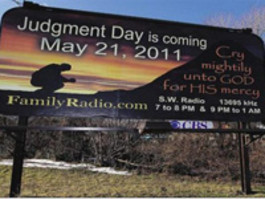
 “JESUS IS COMING TODAY!” If you’re reading this on May 21, 2011, then that is precisely what the followers of Harold Camping are declaring today—Christ is returning to this earth at 6 p.m. (presumably Pacific Time, since Camping lives in Oakland, California). With his return approximately two per cent of this world’s population will be immediately raptured to heaven, leaving the rest of earth’s inhabitants to be destroyed. In an elaborate theological schematic (which I have purused on-line), Camping predicts the return of Christ on May 21, 2011, and five months later the Judgment Day destruction of earth and the universe on October 21, 2011. Harold Camping, a former civil engineer, is the 89 year old founder of Family Radio—a Christian broadcast network that now includes 66 stations globally. He is not a stranger to apocalyptic predictions, having announced that Christ would return on September 6, 1994. His post-September 6 explanation, as he recently told London’s Independent newspaper, is that “at that time there was a lot of the Bible I had not really researched very carefully. But now we’ve had the chance to do just an enormous amount of additional study and God has given us outstanding proofs that it really is going to happen” (http://www.independent.co.uk/news/world/americas/us-preacher-warns . . . ). Camping has developed an intricate but convoluted system of mathematical calculations that assigns numeric values to biblical themes (redemption, heaven, wrath, judgment, et al), and then multiplies them in order to arrive at time frames. For example, this is from his online paper: “Let us return now to the 722,500.07 days from April 1, 33 A.D. (the day Christ was crucified and died) until May 21, 2011 (the day when God’s salvation plan has been altogether completed and all of the true believers are brought, or raptured into Heaven). The number 722,500 is made up of two sets of identical significant numbers. Each number is intimately related to God’s salvation plan: 5 x 10 x 17 x 5 x 10 x 17 = 722,500. The atonement or redemption demonstrated by Christ’s suffering and death on April 1, 33 A.D. (the number 5) is 100% completed on May 21, 2011 (the number 10) when all the true believers are raptured into Heaven (the number 17)” (http://www.familyradio.com/graphical/literature/tracts/frames/index.html). Based on those “calculations” sincere followers of Camping have erected 2000 billboards and crisscrossed every state of this nation with brightly painted camper vans proclaiming the end of the world today, May 21. But why blog at all about a small apocalyptic movement the secular press has patronizingly dismissed? Here’s why: because while I unequivocally reject Harold Camping’s misguided at best calculations for the end of the world, I must confess to a quiet admiration for the chutzpah of his followers who have risked public ridicule in order to share with the world their deeply held conviction that Jesus is soon to return. I, too, call myself an “adventist” (one who believes in Christ’s soon coming)—what is more, I am a Seventh-day Adventist—but how many of my friends and neighbors have heard me recently testifying to my belief that Jesus is coming soon? Call for a show of hands in worship, and mine quickly shoots up. But ask for a public testimony outside of my congregational comfort zone, and I am strangely silent. Are you the same? What’s wrong with us? Listen to the humbled but still bold Big Fisherman, Peter: “The end of all things is near” (I Peter 4:7). No equivocation there—and he was writing nearly two millennia before our day. “Always be prepared to give an answer to everyone who asks you to give the reason for the hope you have. But do this with gentleness and respect” (3:15). Clearly “hope” is not dependent upon a calculable date for Jesus’ return (who himself declared such calculations futile—Matthew 24:36). Hope rests instead upon the bedrock promise of Christ himself: “Look, I am coming soon!” (Revelation 22:12) And it is that divine and biblical certainty that must compel us who still call ourselves “Adventists.” May 21 will come and go. But taking a page from the play book of Harold Camping’s followers, shall we not—as followers of the soon-coming Christ—determine that what will not come and go is our fervent hope and hope-filled witness for our Savior?
May 11, 2011

 A dripping, blood-red X over the face of Osama bin Laden is the cover for the May 20, 2011, issue of TIME. Only four times in its publishing history has the magazine chosen to red-X the face of a notorious human being: Adolf Hitler, Saddam Hussein, Abu Mousab al-Zarqawi and now Osama bin Laden. The press is still abuzz over the stunning surprise and speed with which “the world’s #1 terrorist” was hunted and killed last week. When late on Sunday night President Obama announced bin Laden’s death to the nation and world, jubilant crowds quickly amassed outside the White House and in New York City to celebrate the death of the September 11 mastermind. Seal Team 6 celebrates its precision execution of the raid—Pakistan protests violation of its sovereignty—and earth marvels over the United State’s relentless and finally successful pursuit of its most-wanted nemesis. And how is it with earth’s Christians? As I watched the jubilation of the crowds, read the editorials and followed the unfolding story, the irony of it all occurred to me—we have found reason to rejoice in the death of another. We party because our enemy has been slain. And who would renounce the strong sense of relief family members of the September 11 victims experienced with the news that the perpetrator of that heinous crime had met his own untimely death? “Justice has been done,” was the President’s somber pronouncement. But does God rejoice in the death of Osama bin Laden? King David fled for his life, when his rebel son Absalom lead a coup d'état in Israel to overthrow his father. But days later when the army of the father overpowered the army of the rebel son and Absalom was slain by a commando team, there was no party back at headquarters. Instead the father king wept: “‘O my son Absalom—my son, my son Absalom—if only I had died in your place! O Absalom my son, my son!’” (II Samuel 18:33) On hearing the king’s loud lamenting, Joab—David’s commanding general—burst into the royal chamber with the angry charge that the king’s inconsolable weeping was a disgrace to the nation. But was it? Could it be that David’s weeping was a shadowy representation of another Father King? Will God and the universe party when rebel son and fallen angel Lucifer at last suffers eternal death for his ruthless and unrelenting crimes against the kingdom? Or like David, will the Father of us all bow his head in his hands and weep, “If only I could have died in your place?” Will divine love love its enemies, its nemesis enemy, to the very end? Calvary is answer enough, is it not? “‘Father, forgive them, for they do not know what they do’” (Luke 23:34). And that is why there will be only one death the universe will ever truly rejoice over throughout eternity: “And they sang a new song . . . ‘Worthy is the Lamb who was slain!’” (Revelation 5:9, 12). It is that death, the death of Christ our Savior, that compels us to love even our enemies. Which is why in the end the only dripping, blood-red X that will matter for any of us, for all of us, is the one atop Calvary. “And they sang a new song.”
April 28, 2011
Did any of you graduates get up at 4 a.m. yesterday to watch the royal nuptials take their vows in Westminster Abbey? The whole world has gone gaga over the wedding of handsome Prince William and lovely Kate Middleton. And I suppose the Nielsen statistics will reveal that a billion-plus people on earth were glued to their televisions to oooh and aaah over this spectacular third millennial version of the ancient fairy tale. (Confession—I was sound asleep—I’ve already married the princess of my dreams!) God bless the queen and the prince and his new bride. But a day later, I’ve got some very good news for you who walk down this aisle to celebrate your own epoch-making tale. Follow the logic of this string of declarations: (1) “God exalted him [Christ] to his own right hand as Prince and Savior” (Acts 5:31); and (2) “Jesus is not ashamed to call [us] brothers and sisters” (Hebrews 2:11 NIV ‘11). And what are “brothers and sisters” of a Prince called? You got it—princes and princesses. Now look, let’s not take this royals craze too far—but you get the point. The God of the universe incarnated himself in our midst for 30 some years, dying as our Savior, and rising again as our Lord and King. Whether you call him Prince and all of us his brothers and sisters, or whether you call him King of kings and all of us his children—the quiet truth still shines bright: In Christ we are children of royalty. So, graduate, live the life of a radical prince and princess. No glitz and glamour for you. You are a child of the Most High King—and the moment your diploma is in hand tomorrow (or a facsimile thereof), you embark upon a divine mission—the fulfillment of the dream God has had for your life from the day you began to breathe. Where will he take you, where will you go? This much I know. Somewhere out there, there is a little Seventh-day Adventist church (maybe not so little) that truly needs your passion, your talents, your eagerness to serve. Please don’t spend the next year wandering from congregation to congregation (or simply deciding that you’re too busy to find life in a local congregation of any interest). In the words of our namesake here at this university, “I know of but one way: Find a field of labor, ask God to help, take off your coat, and pitch into the work” (John Nevins Andrews). And as you do so, remember that there’s a little village pastor back on your alma mater campus that will be cheering you on. God hasn’t brought you this far in life to make you a pauper. You’re royalty, my friend—so go forth and live like the Prince who calls you to follow!
April 21, 2011
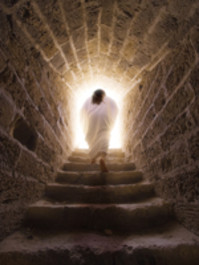
 “FEAR FACTOR OPENS NEW MARKET FOR SEEDS” That headline two days ago caught my eye. What in the world do seeds have to do with fear? I read on. “The news is unquestionably frightening: political turmoil at home and abroad; worries over oil, gas, and food prices; earthquakes, tsunamis, nuclear meltdowns . . . And that’s just in the last few months. Marketers are on high alert. Doomsday is nigh! they shout online and on late-night TV as they hype ‘survivalist seed banks’ and ‘apocalypse gardens’ to the nervous and fearful. More than a dozen companies offer deals of up to 94,000 vegetable seeds, stored in tightly sealed buckets and ‘ammo boxes,’ that will feed a family of four for years or decades” (http://articles.philly.com/2011-04-18/news/29443489_1_vegetable-seeds-lettuce-plant-garden). Can you believe it? You can now order 94,000 vegetable seeds to pack away in your basement or bottom drawer in the event of an emergency! Just in case. Are people buying? “‘It’s going well, a little too well right now. We didn’t really anticipate that we’d get busier every time something happens,’ says Dustin Merritt, co-owner of Emergencyseedbank.com in American Fork, Utah.” In fact, Merritt claims that his company is doing as much business now per month as it did in three months last year. Not everybody’s a believer, of course. “If disaster struck, how would anyone be able to even start a garden, let alone keep one going for 10 or 20 years?” And besides, as one master-gardener quipped, “You don’t need to buy thousands of seeds unless you’re going to feed the whole country.” The point? Like the rest of the world, Americans are easily spooked. And the spate of bad news of late has jacked the profits of survivalist sales. But are 94,000 seeds really going to save us? But on this Passion weekend when Christendom relives the explosive story of Jesus’ resurrection 2000 years ago, the juxtaposed ideas of seed and fear may not be as farfetched as we think. For in that garden tomb outside Jerusalem’s walls the divine Seed was buried behind a stone door. Just one Seed. But in that Seed the survivalist hopes of an entire race were pinned. For if that buried Seed were to rise from the earth—alive and eternal—then the survival, the salvation of the human race would be assured, and fear—the endemic reality of life on this rebel planet—would be conquered. And so it was that in the angel’s cry, “He is not here—He is risen!”, the triumph of the Seed and the salvation of the world were pronounced. And so it is that we gather to celebrate the Risen Christ every time we worship! Then ponder the words of the poet, John M. C. Crum, in this paean of praise for our Savior Seed: Now the green blade rises from the buried grain Wheat that in dark earth many days has lain Love lives again, that with the dead has been Love is come again like wheat arising green. In the grave they laid Him, love by hatred slain Thinking that He would never wake again Laid in the earth like grain that sleeps unseen Love is coming again like wheat arising green. Forth He came in triumph, like the risen grain He that for three days in the grave had lain Raised from the dead, my living Lord is seen Love is come again like wheat arising green. When our hearts are wintry, grieving, or in pain Your touch can call us back to life again Fields of our hearts that dead and bare have been Love is coming again like wheat arising green.
- ‹ previous
- 46 of 64
- next ›